This page introduces the main research themes pursued in our laboratory. All images shown are schematic illustrations for explanatory purposes.
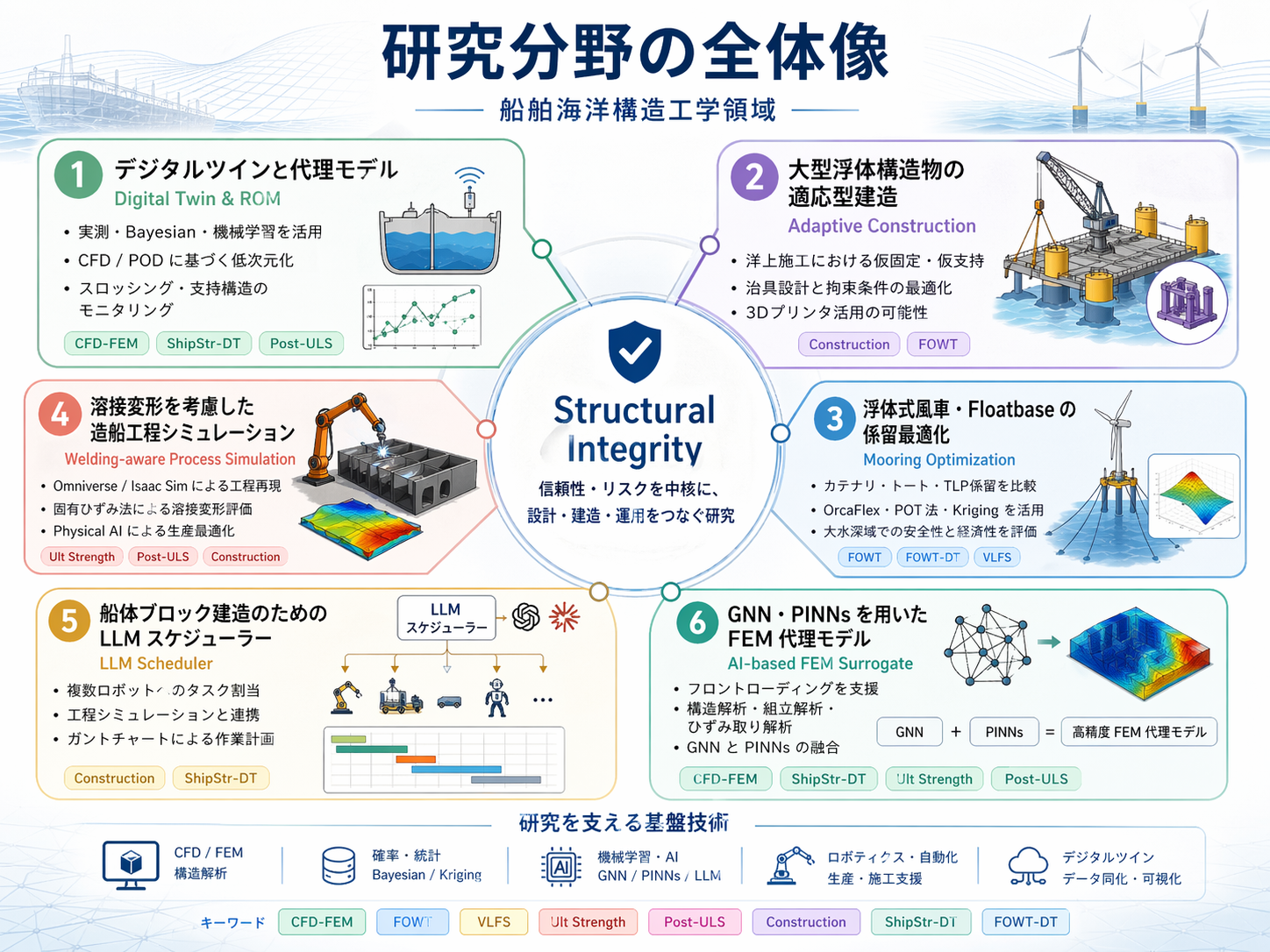
Our laboratory conducts a wide range of research on ships and ocean structures, including structural integrity assessment, numerical simulation, digital twins, floating offshore wind turbines, offshore construction, shipbuilding DX, and robotics. In particular, we promote research that integrates CFD, FEM, statistical methods, machine learning, and AI to support the stages of design, construction, and operation in a comprehensive manner.
Our research is organized around the core areas of Digital Twin, CFD-FEM, FOWT, VLFS, Ult Strength, Post-ULS, Construction, and Reliability / Risk.
By organically combining experiments, numerical analysis, and data-driven approaches, we aim to improve the safety, reliability, and productivity of ships and ocean structures.
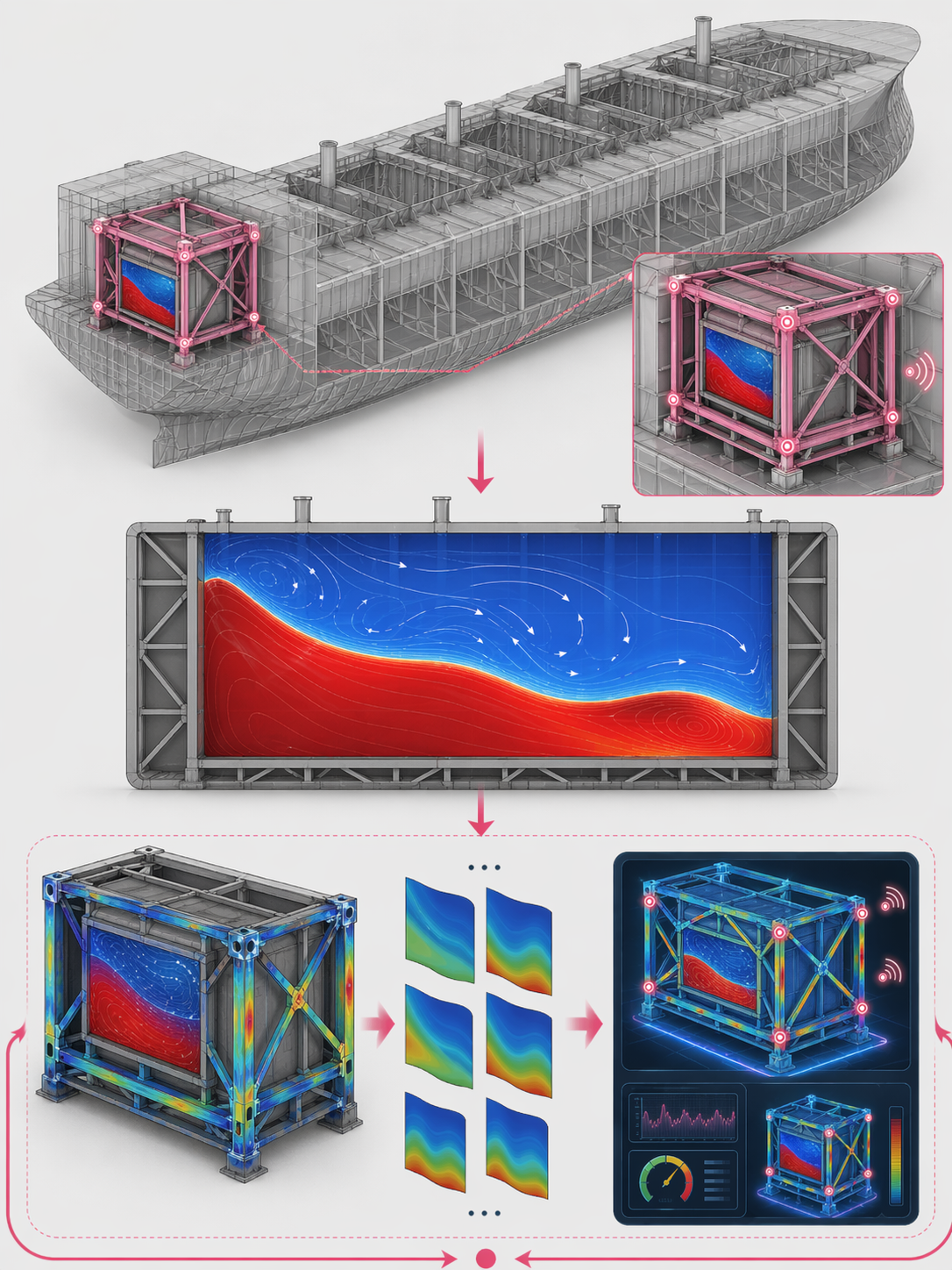
To understand the structural health of alternative-fuel tanks and their supporting structures with both high accuracy and efficiency, we are conducting research on digital twins and surrogate models (ROM: Reduced Order Model).
High-fidelity CFD-FEM analysis can reproduce complex phenomena in detail, but it also involves high computational cost. Therefore, for problems such as sloshing, we explore the use of reduced-order models and POD-based approaches to achieve practical accuracy with significantly reduced computation time.
We also consider applications to structural monitoring and response estimation of real structures.
Keywords: Digital Twin, ROM, CFD-FEM, POD, sloshing, structural monitoring
Adaptive Construction Methods for Large Floating Structures#
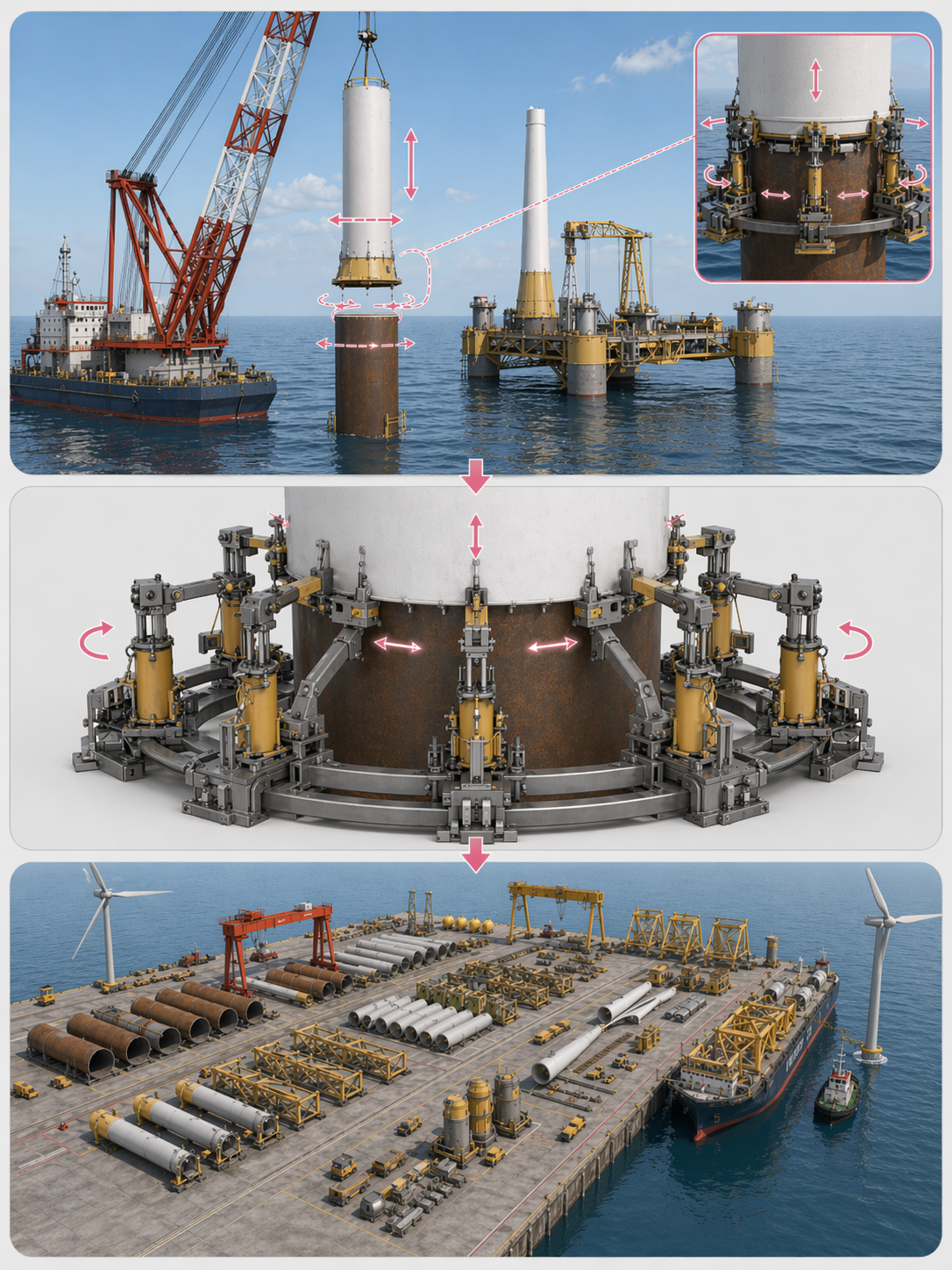
Unlike construction inside a dock, on-site construction of offshore wind turbines and floatbases is continuously affected by wave-induced relative motion.
In response, our laboratory focuses on temporary fixation, temporary support, and fit-up processes, and studies jigs and constraint methods that can function optimally under varying conditions.
We also evaluate the feasibility of adaptive construction methods from the viewpoints of jig strength and workability, and explore the possible use of 3D printing for jig fabrication.
Keywords: offshore construction, adaptive construction, jig design, OrcaFlex, SSODAC, 3DP
Mooring Optimization for Floating Wind Turbines and Floatbases#
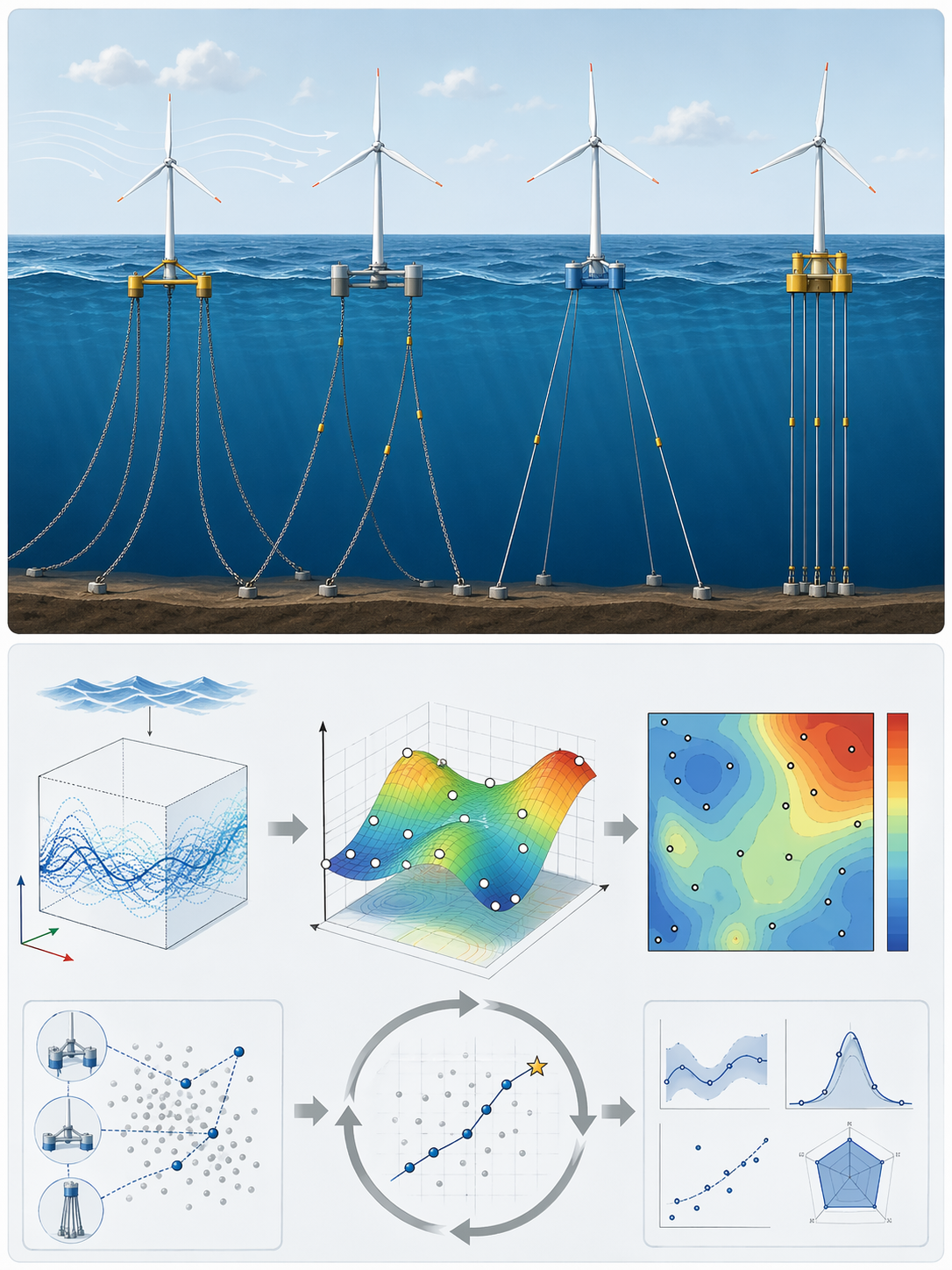
For floating offshore wind turbines and floatbases installed in deep water, mooring system design is a critical issue that governs both safety and economic performance.
Our laboratory studies catenary mooring, taut mooring, TLP systems, and related configurations, aiming to efficiently evaluate maximum responses under combined wind and wave loading and to identify optimal design parameters.
By combining OrcaFlex response analysis, POT-based statistical processing, and Kriging-based response surface construction, we pursue mooring optimization that also accounts for uncertainty.
Keywords: FOWT, Floatbase, mooring, OrcaFlex, POT method, Kriging
Shipbuilding Process Simulation Considering Welding Distortion#
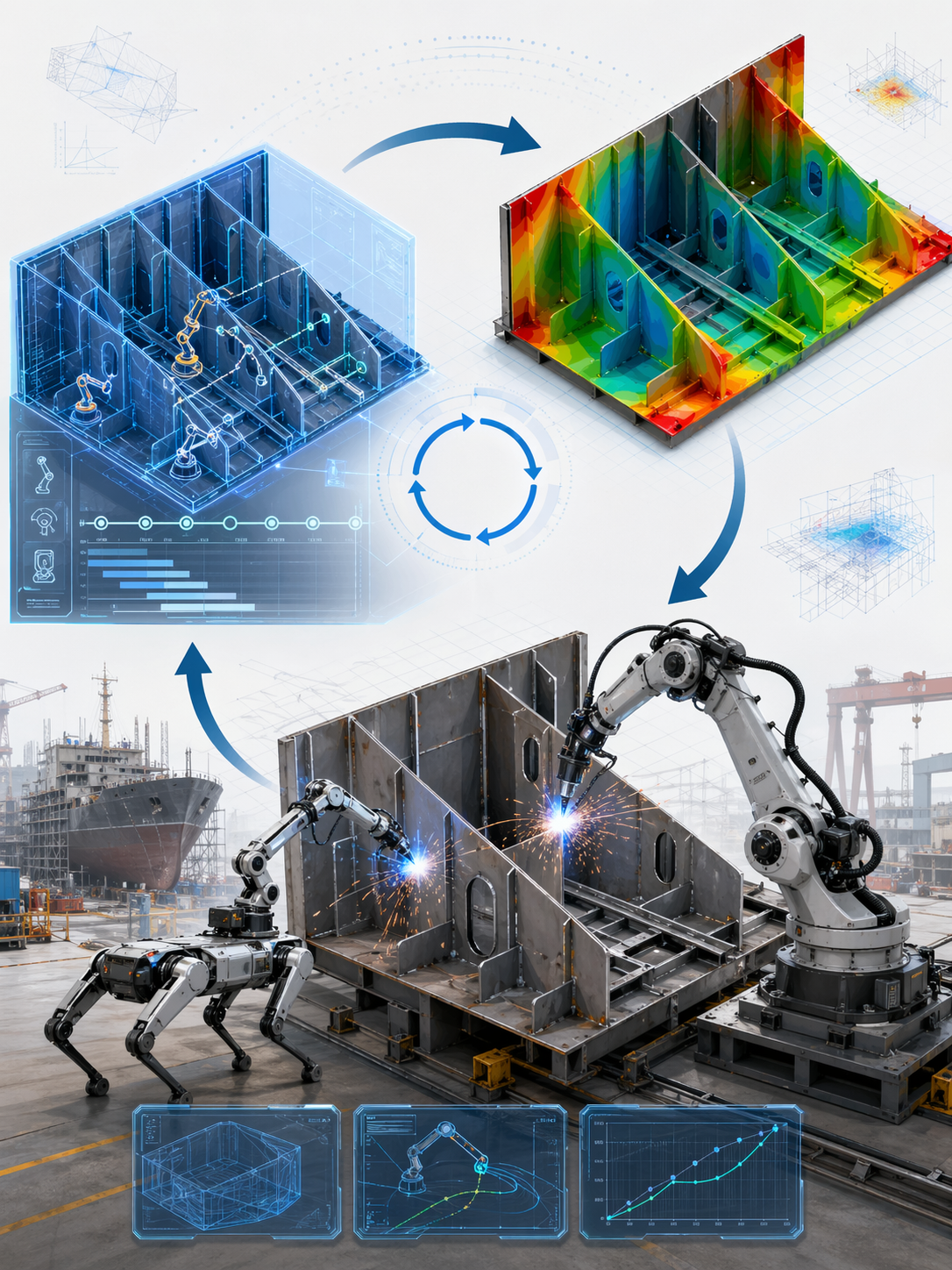
Against the background of labor shortages and increasing demand for efficiency in the shipbuilding industry, automation and optimization of production processes using robots are attracting growing attention.
Our laboratory is conducting research on process simulation for hull block assembly, where robot work plans are generated while accounting for welding distortion.
By combining virtual environments such as NVIDIA Omniverse / Isaac Sim with welding distortion evaluation based on the inherent strain method and the inherent deformation method, we aim to reproduce shipbuilding processes in a more realistic manner.
Keywords: shipbuilding DX, Physical AI, Omniverse, Isaac Sim, welding distortion, process optimization
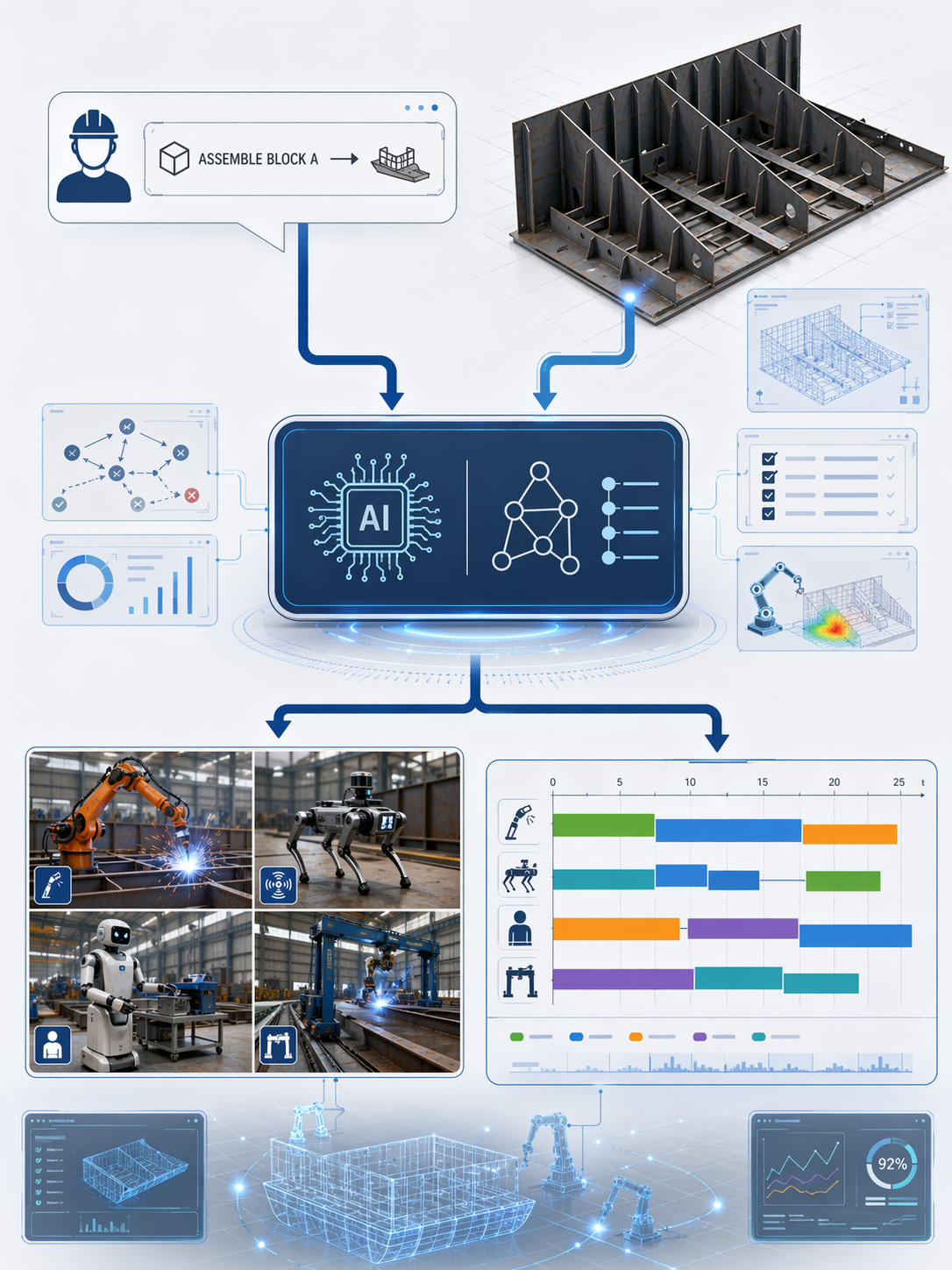
Looking toward future shipyards where diverse robots will work together, we are also studying schedulers that can appropriately assign tasks to multiple robots.
This research explores a framework in which LLMs are used to generate task structures from work instructions and optimally allocate tasks to each robot.
By combining this with process simulation for feasibility evaluation, we aim to advance collaborative robotic construction of hull blocks.
Keywords: LLM, task planning, robot collaboration, shipbuilding automation, gantt chart generation
Development of FEM Surrogate Models Using GNNs and PINNs#
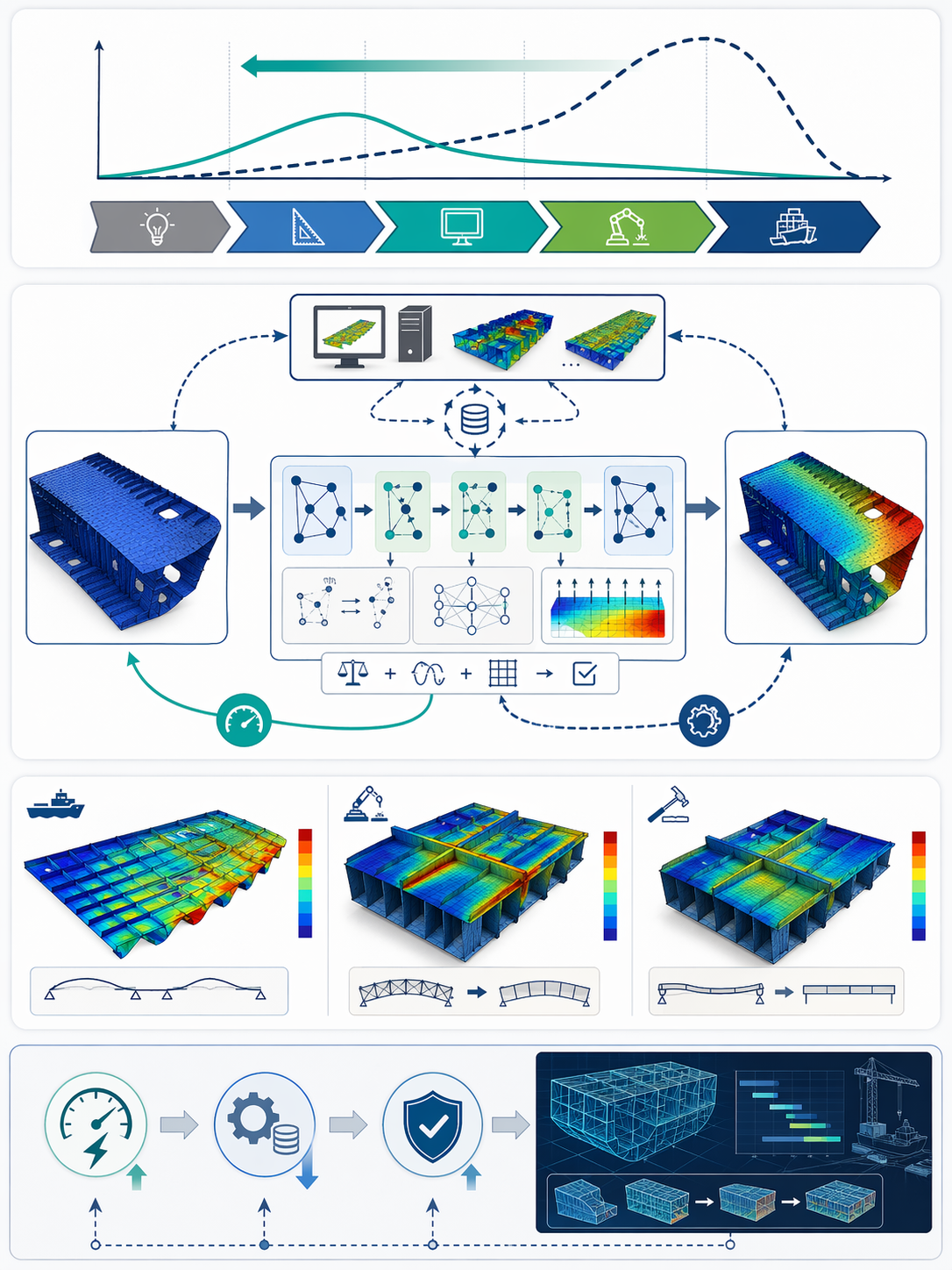
To realize front-loading in design and production planning, high-performance surrogate models with low computational cost are essential.
Our laboratory is developing FEM surrogate models for ship structures by combining GNNs (Graph Neural Networks) and PINNs (Physics-Informed Neural Networks).
With applications in stress analysis, block assembly analysis, and fairing analysis in mind, this research aims to establish an analytical foundation that contributes to shorter development periods, lower costs, and improved quality.
Keywords: GNN, PINNs, FEM, surrogate model, front-loading, structural analysis
In addition to the traditional foundations of structural mechanics, fluid mechanics, and construction engineering, our laboratory is promoting a new generation of naval architecture and ocean engineering research that integrates data-driven analysis, AI, and robotics. We will continue to address engineering challenges rooted in real seas and real structures, and strive to create technologies that support safer and more sustainable use of the ocean.